The Better Decision Project
Collections
Foundations
Decision Making
Coming Soon
Leadership
Coming Soon
Governance
Coming Soon
Crisis Leadership
Coming Soon
Organizational Culture
Coming Soon
Strategy
Coming Soon
Research
Coming Soon

The Architecture of Judgment
Better Questions
Better decisions begin before we search for answers. The way we frame a problem determines what information we notice, which alternatives we consider and ultimately what decisions become possible.
6 Minutes
Read Article

The Architecture of Judgment
The First Five Minutes
In the first moments of a crisis, information is scarce, emotion is high and people want answers before leaders have them. The first job is not to solve everything—it is to create enough clarity and structure for the organization to begin acting effectively.
6 Minutes
Read Article

The Architecture of Judgment
The Ground Still Dictates
The person with the most authority may not have the best information about a changing situation. Good judgment requires bringing information, expertise and authority together as close as practical to the reality that requires the decision.
4 minutes
Read Article

The Architecture of Judgment
The Crisis Started on an Ordinary Wednesday
Organizations build their capacity for crisis in ordinary interactions. Trust, psychological safety, information sharing and relationships determine whether important information can move when uncertainty and consequences are high.
6 minutes
Read Article

The Architecture of Judgment
When Not Deciding Is a Decision
Waiting can be good judgment. But waiting is not neutral. Time, opportunities, risks and consequences continue moving while we decide, making the choice to wait part of the decision itself.
7 Minutes
Read Article

The Architecture of Judgment
Judgment Is Built Before It Is Needed
The decisions we make under pressure may happen in minutes, but the capability behind them can take years to develop. Better judgment is built through experience, practice, feedback and deliberate opportunities to think before the stakes are high.
8 Minutes
Read Article

The Architecture of Judgment
The Architecture of Judgment
Good judgment is not created in the moment a decision arrives. It is built through experience and practice, exercised through sensing and judging, translated into action, and strengthened through learning.
3 Minutes
Read Article

Judgment Under Uncertainty
Deciding With Incomplete Information
We rarely have all the information we would like before a consequential decision must be made. Good judgment means understanding what matters, what remains unknown, and when waiting for greater certainty costs more than it provides.
7 Minutes
Read Article

Judgment Under Uncertainty
Risk vs. Uncertainty
Risk and uncertainty are not the same. Risk can often be estimated; uncertainty requires interpretation. Good judgment begins by understanding which kind of unknown we are actually facing.
7 Minutes
Read Article

Judgment Under Uncertainty
How Much Information Is Enough?
More information does not automatically produce a better decision. The real question is whether the next piece of information is likely to materially improve what we decide or how we act.
6 Minutes
Read Article

Judgment Under Uncertainty
Dissent and Disagreement
Different perspectives only improve a decision when they actually enter the conversation. Good judgment requires making room for dissent before the decision—and alignment after it.
6 Minutes
Read Article

Judgment Under Uncertainty
Expertise and Its Limits
Expertise helps us see what others may miss. Good judgment requires understanding where that expertise applies, where its boundaries lie, and when the pattern may have changed.
6 minutes
Read Article

The Architecture of Judgment
Better Thinkers Before Better Answers
Better decisions don't come from accumulating more answers. They come from developing people who can ask better questions, think through difficult problems and exercise judgment for themselves.
3 minutes
Read Article

The Architecture of Judgment
Leadership is a Thinking Problem
Leadership is often treated as a promotion rather than a discipline. Better leadership begins by developing the thinking and judgment required to make consequential decisions when complexity grows and the answers aren't obvious.
4 minutes
Read Article

The Architecture of Judgment
A Plan Is Not Preparation
Having a plan and being prepared are not the same thing. Preparation turns plans into capability by giving people the practice, clarity and shared understanding they need to adapt when reality no longer matches what was expected.
5 minutes
Read Article
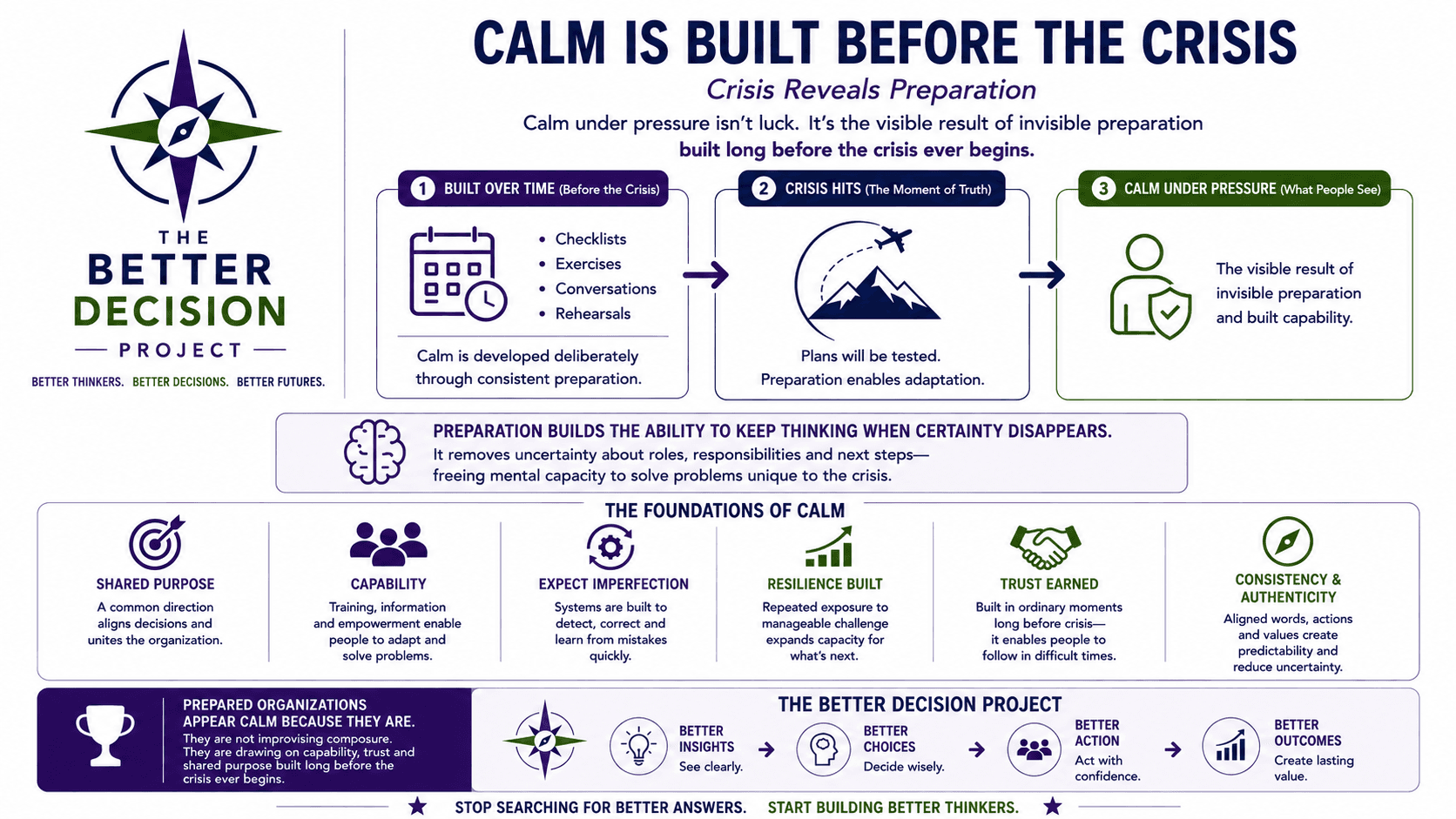
Judgment Under Uncertainty
Calm Is Built, Not Found
Calm under pressure is rarely improvised in the moment. It is the visible result of preparation, capability, resilience, trust and consistency built long before uncertainty arrives.
6 minutes
Read Article