Crisis Leadership
Calm Is Built, Not Found
Crisis doesn't create character. It reveals preparation.
By Steven Hansen
—
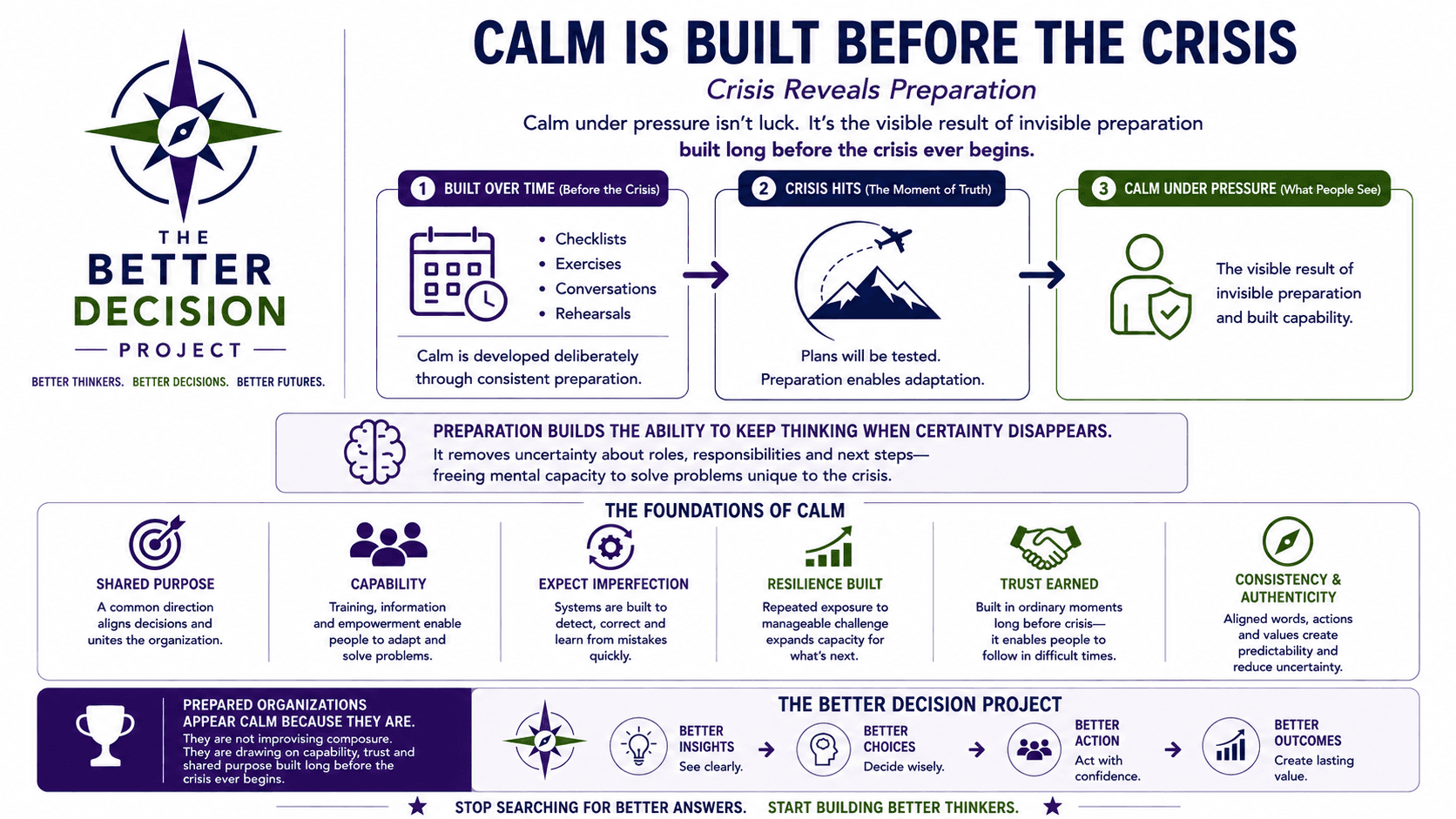
We often describe certain leaders as being calm under pressure. We speak as though calm is a personality trait; something a fortunate few simply possess when everything around them begins to fall apart. I’ve come to believe that’s not really what’s happening. The people and organizations that appear calm during periods of uncertainty are rarely improvising that composure in the moment. More often, we’re seeing the accumulated effect of work that was done long before the crisis arrived. Calm is built, not found.
I’ve spent a good part of my career working in environments where plans have a habit of colliding with reality. Military operations, emergency response, executive leadership and even ordinary organizational life have reinforced the same lesson: the objective of preparation isn’t to predict exactly what will happen. That’s impossible. The objective is to create enough capability that people can continue to think when the unexpected inevitably occurs.
Preparation serves a purpose that is often overlooked. It creates confidence; not confidence that everything will go according to plan, but confidence that the organization is capable of adapting when it doesn’t. Preparation buys something far more valuable than certainty. It buys the ability to keep thinking when certainty disappears. Every exercise, after-action review, difficult conversation and rehearsal removes a little uncertainty from the moment when it matters most. People don’t need to expend precious mental energy inventing roles, understanding responsibilities or determining who should act next because some of that work has already been done. Their attention remains available for the problems nobody anticipated.
I saw the same principle at work during the pandemic. Strategic planning didn’t suddenly provide our executive team with certainty about what the next three years would bring. None of us knew. What the process did provide was a common direction, a shared sense of purpose and confidence that, whatever came next, we could navigate it together. Looking back, I’ve come to appreciate that hope can be more than an emotion. In organizations facing uncertainty, hope can become an operational capability. It provides the confidence to continue making thoughtful decisions after certainty has disappeared.
That confidence doesn’t reside within individuals alone. Capability isn’t simply about what people know; it’s also about what organizations know together. When people share a clear understanding of purpose, they begin to move beyond asking, “What does my department need?” and toward asking, “What does the organization need?” That subtle shift changes the quality of both conversations and decisions. Shared purpose becomes one of the quiet advantages prepared organizations carry with them when circumstances become difficult.
Organizations often believe that control produces consistency. Experience has taught me something different. Capability produces consistency. People who understand the purpose of their work, possess the necessary training and have access to the right information don’t require constant supervision to respond intelligently when circumstances change. They understand not only what they are doing, but why they are doing it, which allows them to adapt while continuing to move toward the intended outcome. The role of leadership is not to create dependence. It is to build capability.
Building that capability also requires us to acknowledge human fallibility. Prepared organizations aren’t those that assume mistakes won’t occur; they’re the ones that expect them and deliberately create systems capable of identifying, correcting and learning from them quickly. This is an important distinction. Preparation isn’t built on an assumption of perfection. It is built on an expectation of imperfection. The goal isn’t to create an organization in which nobody makes a mistake. The goal is to create one capable of recognizing when reality has departed from expectation and adjusting before the consequences compound.
The same is true of resilience. We sometimes talk about resilience as though people suddenly discover it when adversity strikes. In my experience, resilience is accumulated much more gradually. Every uncomfortable assignment, demanding project, difficult conversation and problem solved under pressure quietly expands our capacity for the next one. We rarely appreciate those experiences as preparation while we’re living them. Looking backwards, however, many of the experiences I was least enthusiastic about at the time became the ones that prepared me best for leadership under pressure. Resilience isn’t created by the crisis. The crisis reveals how much resilience was built beforehand.
I’ve also come to appreciate that trust is built in remarkably ordinary moments. It grows through hundreds of interactions that seem almost insignificant at the time: learning someone’s name, asking about their family, listening carefully, following through on commitments, admitting mistakes and treating people with dignity. None of those actions feel like crisis preparation, yet they become invaluable when uncertainty arrives. Leaders frequently ask people to follow them into difficult territory, but the trust required to do so isn’t created in the first five minutes of an emergency. It has been accumulating for months, sometimes years. When the pressure arrives, people don’t suddenly decide whether they trust your leadership. Much of that decision has already been made.
Finally, one of the most overlooked contributors to calm may simply be consistency. People think more clearly when they know what to expect from those around them. Leaders whose words, actions and values remain aligned over time create an element of predictability even when circumstances themselves are unpredictable. Authenticity, viewed this way, isn’t simply about being genuine. It reduces uncertainty. People may not know what decision you are going to make, but they understand the principles that will guide you in making it.
These ideas—preparation, capability, acceptance of fallibility, resilience, trust and consistency—can appear disconnected when we examine them individually. Increasingly, I see them as parts of the same system. Together, they create the conditions in which people and organizations can continue to think when pressure rises and certainty disappears. They don’t guarantee the right answer, eliminate fear or prevent mistakes. What they do is preserve our capacity to exercise judgment when judgment matters most.
Perhaps that’s why calm can look so effortless from the outside. We see the behaviour in the moment, but we don’t see the years of preparation underneath it. We see the leader who remains composed, but not the experiences that built their resilience. We see the team adapt, but not the training and shared understanding that created its capability. We see people extend trust, but not the hundreds of ordinary interactions through which that trust was earned.
Calm isn’t luck. It isn’t personality. It isn’t bravado, and it isn’t the absence of fear. It is the visible result of invisible preparation.
The work happens beforehand.
The crisis simply reveals what we’ve built.